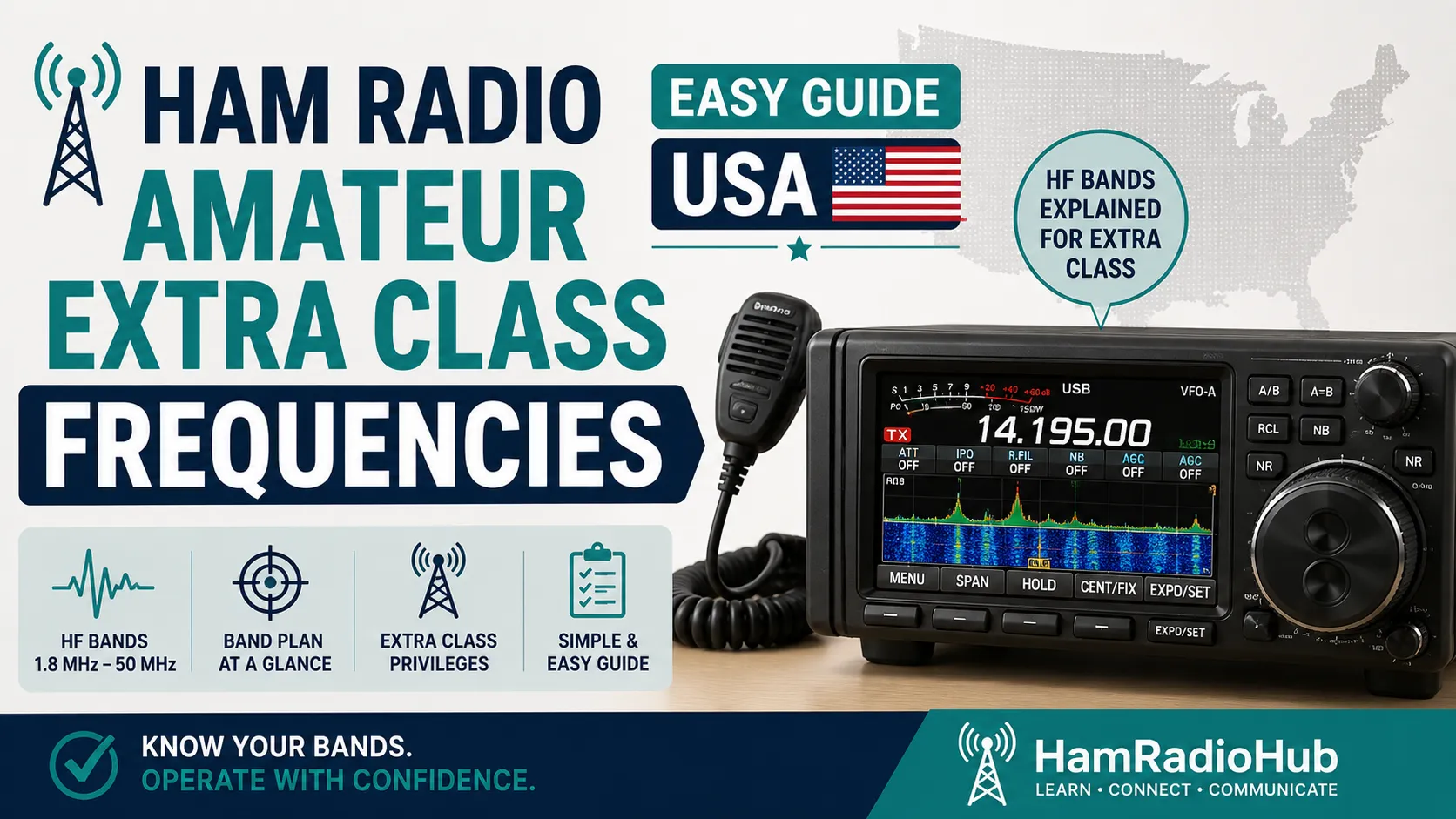
If you’ve been chasing DX on 20 meters with your General ticket and keep hearing about “Extra-only” sub-bands you can’t quite reach, you already know why this license matters. The Amateur Extra class is the top rung of the US amateur radio ladder, and it’s the only license that opens up the entire ham radio spectrum to you. This guide walks through exactly what that means, which frequencies you gain, and how the whole three-tier licensing system fits together.
As of January, 2026 there are no major changes in Amateur Extra Class Privileges.
What Is the Amateur Extra Class License?
The Amateur Extra class license is the highest of the three amateur radio license classes issued in the United States today. It gives you operating privileges on nearly every frequency band and mode allocated to amateur radio, including several narrow “Extra-only” segments that Technician and General licensees simply can’t touch.
Anyone can start this journey. Most newcomers begin with the entry-level Technician license, move up to General once they’re ready to explore HF, and eventually test for Extra when they want full access to the amateur bands. There’s no requirement to rush the process — plenty of operators stay happily at General or even Technician for years before deciding to upgrade.
How the Three License Classes Work Together:
It helps to think of the licensing system as a staircase, with each step unlocking more of the radio spectrum:
- Technician Class – the entry point for new hams, with full VHF/UHF privileges and a small slice of HF access.
- General Class – opens up the majority of the HF bands, giving you access to roughly 80% of the amateur HF spectrum and a much wider range of operating modes.
- Amateur Extra Class – grants privileges across essentially the entire amateur radio frequency allocation, with only a handful of mode-specific restrictions.
To sit for the General exam, you need to already hold a Technician license (or have just passed the Technician exam in the same session). The same rule applies going from General to Extra — you either hold a current General license or you’ve just passed that exam element. There’s no way to skip a step and go straight to Extra.
A Quick History Lesson: Novice, Technician Plus, and Advanced Class
If you’ve read older ham radio material, you may have run into license classes that no longer exist. Here’s the short version of what changed:
- Novice Class was discontinued effective April 15, 2000. No new Novice licenses are issued, though existing ones remain valid and renewable indefinitely. Technician licensees are automatically granted all former Novice privileges.
- Morse code testing was dropped from all license classes effective February 23, 2007, which removed a barrier that had kept many people from pursuing HF privileges.
- Technician Plus Class was folded into the standard Technician class in 2000. Existing Tech Plus licenses converted to Technician upon renewal or modification, so the two are now functionally identical.
Advanced Class, which used to sit between General and Extra, was also abolished effective April 15, 2000. No new Advanced licenses are issued, but existing ones remain valid indefinitely and carry additional HF privileges beyond General. The Amateur Extra license includes everything an Advanced license offers, and then some.
Understanding this history matters because it explains why some older license manuals or forum posts reference license classes you can’t actually apply for anymore.
How Do You Actually Get an Amateur Extra Class License?
You earn the Amateur Extra license by passing a written examination. These exams aren’t administered by the FCC directly — they’re given by Volunteer Examiner Coordinators (VECs), organizations authorized by the FCC to coordinate amateur radio testing across the country. The ARRL VEC is one of the most widely used, but there are several others operating nationwide.
The Extra class exam covers more advanced material than General, including deeper electronics theory, antenna design, and FCC rules specific to the additional privileges you’re gaining. Once you pass, the FCC issues your upgraded license, and your new privileges typically show up in the FCC’s license database within a few business days.
Amateur Extra Class Frequency Privileges & Operating modes:
This is the part most people come here for. The table below lays out the frequency bands and permitted operating modes available to Amateur Extra class license holders across the LF, MF, HF, VHF, and UHF spectrum.
The table below summarizes the Ham radio Amateur extra class frequencies and operating mode privileges:
| BAND | FREQUENCY RANGE | OPERATING MODES |
|---|---|---|
| LF | 135.7-137.8 kHz (2200m) | CW, RTTY/DATA, PHONE ,IMAGE |
| MF | 472–479 kHz (630m) | CW, RTTY/DATA, PHONE ,IMAGE |
| MF | 1.800-2.000 MHz (160m) | CW, RTTY/DATA, PHONE ,IMAGE |
| HF | 3.525-3.600 MHz (80m) | CW, RTTY/DATA |
| HF | 3.600-4.000 MHz (80m) | CW, PHONE, IMAGE |
| HF | 5332-5405 kHz (60m) | USB ONLY |
| HF | 7.025-7.125 MHz (40m) | CW, RTTY/DATA |
| HF | 7.000-7.125 MHz (40m) | CW, RTTY/DATA |
| HF | 7.175-7.300 MHz (40m) | CW, PHONE |
| HF | 10.100-10.150 MHz (30m) | CW, RTTY/DATA |
| HF | 14.000 – 14.150 MHz (20m) | CW, RTTY/DATA |
| HF | 14.025 -14.150 MHz (20m) | CW, RTTY/DATA |
| HF | 14.150 -14.350 MHz (20m) | CW, PHONE, IMAGE |
| HF | 14.175 -14.350 MHz (20m) | CW, PHONE, IMAGE |
| HF | 14.225 -14.350 MHz (20m) | CW, PHONE ,IMAGE |
| HF | 18.068-18.110 MHz (17m) | CW, RTTY/DATA |
| HF | 18.110-18.168 MHz (17m) | CW, PHONE ,IMAGE |
| HF | 21.000-21.200 MHz (15m) | CW, RTTY/DATA |
| HF | 21.025-21.200 MHz (15m) | CW, RTTY/DATA |
| HF | 21.200-21.450 MHz (15m) | CW, PHONE, IMAGE |
| HF | 21.225-21.450 MHz (15m) | CW, PHONE, IMAGE |
| HF | 21.275-21.450 MHz (15m) | CW, PHONE ,IMAGE |
| HF | 24.890-24.930 MHz (12m) | CW, RTTY/DATA |
| HF | 24.930-24.990 MHz (12m) | CW, PHONE ,IMAGE |
| HF | 28.000-28.300 MHz (10m) | CW, RTTY/DATA |
| HF | 28.300-28.500 MHz (10m) | CW, PHONE |
| HF | 28.300-29.700 MHz (10m) | CW, PHONE ,IMAGE |
| VHF | 50.0-50.1 MHz (6m) | CW ONLY |
| VHF | 50.1-54.0 MHz (6m) | CW, RTTY/DATA, PHONE ,IMAGE, MCW |
| VHF | 144.0-144.1 MHz (2m) | CW ONLY |
| VHF | 144.1-148.0 MHz (2m) | CW, RTTY/DATA, PHONE ,IMAGE, MCW |
| VHF | 222.00-225.00 MHz (1.25m) | CW, RTTY/DATA, PHONE ,IMAGE, MCW |
| UHF | 420.0-450.0 MHz (70cm) | CW, RTTY/DATA, PHONE ,IMAGE, MCW |
| UHF | 902.0-928.0 MHz (33cm) | CW, RTTY/DATA, PHONE ,IMAGE, MCW |
| UHF | 1270-1295 MHz (23cm) | CW, RTTY/DATA, PHONE ,IMAGE, MCW |
| UHF | 1240-1300 MHz (23cm) | CW, RTTY/DATA, PHONE ,IMAGE, MCW |
What Operating Modes Can Extra Class Operators Use?
Amateur Extra privileges cover the full range of modes recognized under FCC Part 97 rules:
- CW (Morse code) – still required knowledge for the exam pools, and many Extra-only sub-bands are CW/data only.
- RTTY/Data – radio teletype and digital modes like FT8, PSK31, and similar.
- Phone – voice communication, by far the most popular mode among the majority of licensees.
- Image – modes like slow-scan television (SSTV) and fax.
- MCW (Modulated Continuous Wave) – Morse code telegraphy that modulates the carrier using audio tones, mostly used on VHF/UHF.
Morse code proficiency isn’t required to pass any current license exam, and its everyday use has declined as a result. Phone remains the go-to mode for most amateur operators, and the 2-meter band (144.1–148.0 MHz) is consistently the most heavily used band across every license class, largely thanks to the popularity of local FM repeaters.
Ham radio amateur extra class frequencies || pdf download
I have prepared a simple pdf for referring ham radio amateur extra class frequencies and privileges. Click here for the download
Advantages of Upgrading to Amateur Extra
The clearest benefit of the Extra class license is sheer breadth of access — you gain the widest possible range of frequencies and the greatest flexibility in operating modes of any US amateur license. Extra-only segments at the bottom of the HF bands tend to be less crowded, which is a real advantage during contests and DX pileups.
The tradeoff, if you want to call it that, is the path to get there. You’ll need to pass both the Technician and General exams before you’re even eligible to sit for the Extra exam, and the Extra question pool covers noticeably more technical ground. For most operators, though, that extra study time pays off the first time they work a rare DX station on a frequency a General license simply can’t reach.
Ham radio Amateur extra class frequencies: Conclusion
If you’re studying for the Extra exam, focus your time on the sections that trip up most candidates: circuit theory, antenna characteristics, and the specific frequency privileges outlined above. Print or save a copy of the band chart and keep it near your radio until the numbers become second nature — even experienced operators double-check edge frequencies before transmitting near a band boundary. And once you’ve got that Extra ticket in hand, take some time to actually explore the new spectrum you’ve gained rather than just adding it to your license record. That’s where the real value of upgrading shows up.
FAQs:
Do I need to pass a Morse code test to get my Amateur Extra license?
No. The FCC eliminated Morse code testing requirements for all license classes back in 2007. The current Extra class exam focuses on advanced electronics theory, antenna systems, and FCC regulations instead. You’ll still find CW privileges throughout the amateur bands, but you don’t need to demonstrate code proficiency to earn any US amateur license today.
How long does an Amateur Extra class license last, and do I need to renew it?
Amateur radio licenses, including Extra class, are valid for ten years from the date of issue or renewal. You can renew through the FCC’s Universal Licensing System either shortly before or within a grace period after expiration, without retesting, as long as you renew before that grace period runs out.
Can I operate on Extra-only frequencies immediately after passing the exam, or do I need to wait for my license to arrive by mail?
You can typically operate as soon as your new license privileges appear in the FCC’s license database (ULS), which usually happens within a few business days of your exam being processed by the VEC. You don’t need to wait for a physical license certificate to arrive in the mail.
Other blog posts from the category:
- Wide Band vs Narrow Band: Which is better for Ham Radio?
- HF Band conditions: A Comprehensive Guide
- HAM radio Frequencies & Bands in the USA: Popular frequencies with chart || Updated January 2025
- Ham Radio Emergency Frequencies: Must Know During Disasters || Updated 2025
- HAM radio General class privileges || Easy Guide USA (Updated 2025)
- Ham Radio Technician Class Privileges: A Complete Beginner’s Guide (USA 2026)
- Amateur Extra Class License: The Complete Guide to Frequencies and Privileges (Updated 2026)

