Ham Radio Technician class privileges: Introduction
If you’ve just earned your Technician Class license — or you’re studying for the exam and wondering exactly what you’ll be allowed to do once you pass — you’re in the right place. The FCC hands out a lot of rules across a lot of frequency bands, and it’s easy to get lost trying to figure out which ones actually apply to you as a new operator. This guide breaks down exactly where Technician Class hams can transmit, what modes you’re allowed to use, and why the license is such a solid entry point into amateur radio.
The full amateur radio spectrum runs from 30 kHz all the way up to 300 GHz, but no single license class gets access to all of it. The FCC splits that spectrum into bands, and then splits privileges on those bands by license class. Technician, General, and Amateur Extra operators each get a different slice of the pie. This article focuses entirely on the slice that belongs to Technicians.
What is Ham radio technician class license?
The Technician Class license is the entry-level amateur radio license in the United States, and it’s where almost every ham gets started. It authorizes you to operate on specific frequency bands and modes within the amateur spectrum, with the bulk of your privileges sitting above 30 MHz on the VHF and UHF bands.
Anyone can apply, regardless of experience. If you can pass the written exam, the FCC will issue you a callsign and license, and you can legally get on the air. There’s no need for a mentor, a club membership, or years of study — just a willingness to learn the material.
How Do You Actually Get a Technician License?
You earn a Technician Class license by passing a 35-question written exam. The test is administered by volunteer examiners working under a Volunteer Examiner Coordinator (VEC) that’s accredited by the FCC — in practice, this means you’ll usually test at a local club session, a hamfest, or increasingly, in an online proctored exam.
There’s no age minimum. Kids can and do get licensed, though anyone under 13 needs a parent or guardian to sign the consent portion of the application. And unlike the early days of amateur radio, there’s no Morse code requirement standing between you and your license.
Once you pass, Technician privileges cover voice, Morse code (CW), and digital data communications — but, as you’ll see below, with real limits on which bands you can use for each mode and how much power you’re allowed to run.
Ham radio technician class privileges & operating modes:
This is the part most new hams actually want to know. The table below lays out every band where Technician Class operators have privileges, along with the specific frequency ranges and the modes allowed on each one.
The table below summarizes the technician class privileges and operating modes:
| BAND | FREQUENCY RANGE | OPERATING MODES |
|---|---|---|
| HF | 3.525-3.600 MHz (80m) | CW ONLY |
| HF | 7.025-7.125 MHz (40m) | CW ONLY |
| HF | 21.025-21.200 MHz (15m) | CW ONLY |
| HF | 28.000-28.300 MHz (10m) | CW, RTTY/DATA |
| HF | 28.300-28.500 MHz (10m) | CW, PHONE |
| VHF | 50.0-50.1 MHz (6m) | CW ONLY |
| VHF | 50.1-54.0 MHz (6m) | CW, RTTY/DATA, PHONE ,IMAGE, MCW |
| VHF | 144.0-144.1 MHz (2m) | CW ONLY |
| VHF | 144.1-148.0 MHz (2m) | CW, RTTY/DATA, PHONE ,IMAGE, MCW |
| VHF | 222.00-225.00 MHz (1.25m) | CW, RTTY/DATA, PHONE ,IMAGE, MCW |
| UHF | 420.0-450.0 MHz (70cm) | CW, RTTY/DATA, PHONE ,IMAGE, MCW |
| UHF | 902.0-928.0 MHz (33cm) | CW, RTTY/DATA, PHONE ,IMAGE, MCW |
| UHF | 1270-1295 MHz (23cm) | CW, RTTY/DATA, PHONE ,IMAGE, MCW |
| UHF | 1240-1300 MHz (23cm) | CW, RTTY/DATA, PHONE ,IMAGE, MCW |
Which Operating Modes Come With Technician Privileges?
Technician licensees aren’t limited to just talking into a microphone. Depending on the band, you can use:
- CW (Morse code) — still alive and well on the lower HF segments and the bottom edges of the VHF bands
- RTTY/data — digital modes like packet, APRS, and other computer-based communication
- Phone — standard voice communication, either FM or single-sideband depending on the band
- Image — modes like slow-scan television (SSTV) and fast-scan amateur TV
- MCW (Modulated Continuous Wave) — essentially Morse code carried on an audio tone rather than a pure on/off carrier
In practice, phone is by far the most popular mode among Technicians today. CW has a loyal following, but it’s a shrinking share of on-air activity compared to voice and digital modes. If you listen around, you’ll find the 2 meter band (144.1–148.0 MHz) is where the vast majority of Technician activity happens — it’s affordable, the radios are small, and local repeater networks make it easy to have real conversations from day one.
A Bit of History: What Happened to the Novice Class?
If you’ve read older amateur radio material, you may have come across references to the Novice Class license. The FCC stopped issuing new Novice licenses on April 15, 2000, though existing Novice licensees can still renew indefinitely. Then, effective February 23, 2007, the FCC dropped the Morse code testing requirement across the board. As a result of these changes, Technician Class licensees today are automatically granted all the operating privileges that used to belong exclusively to Novice licensees.
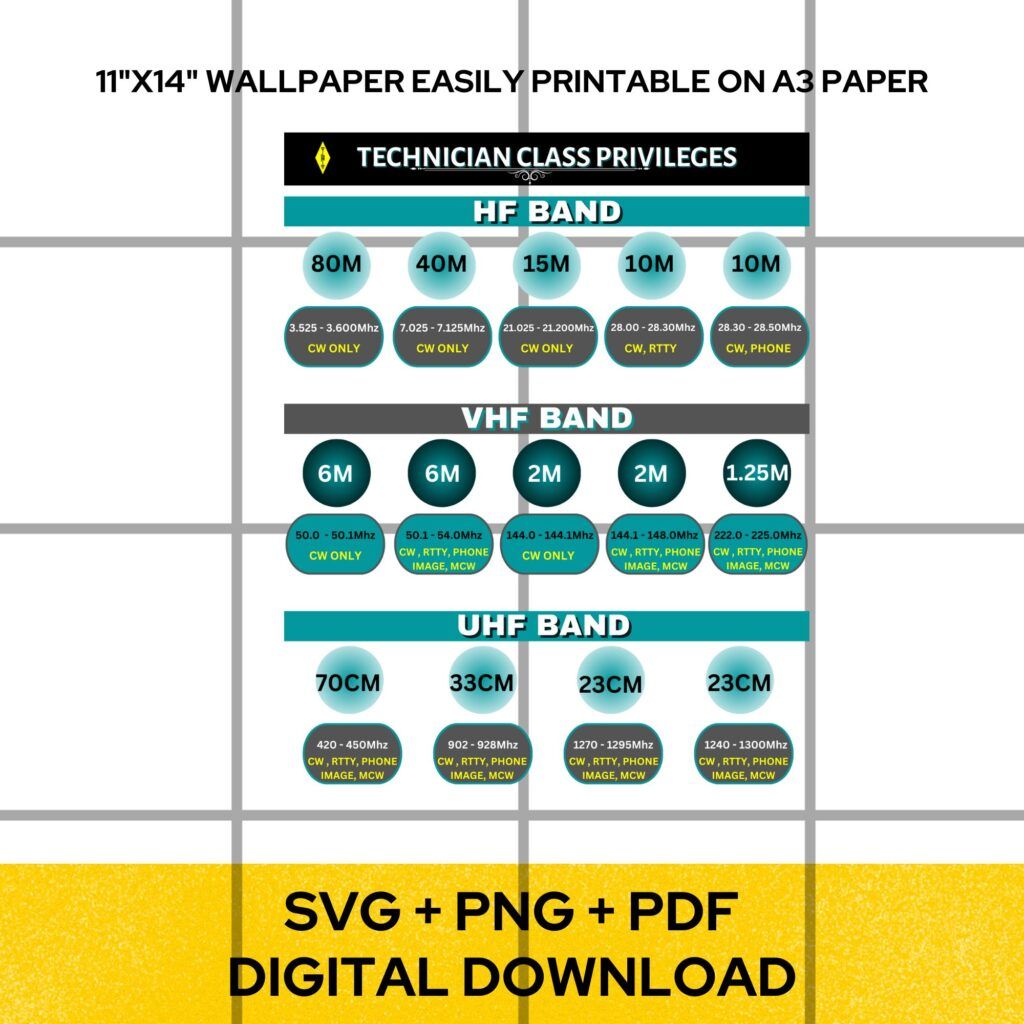
A Handy Reference for Your Shack || pdf download
Because there’s a lot to remember when you’re new, it helps to keep a printed reference nearby until the bands and modes become second nature. HamRadioHub keeps a simple downloadable chart of Technician Class privileges available for exactly this purpose — something you can print out and stick above your operating desk while you’re still getting your bearings.
I have prepared a simple pdf for referring technician class privileges and operating modes. Click here for the download
You can also Buy this beautiful printable Technician Class Privileges Digital Download that you can print and paste on your Ham Shack or Ham Station Desk at a very minimal cost of 4.99$. (Please do support us as it keeps this blog alive)
Click this link to view this product: Technician class privileges digital
FAQs on Ham radio technician class privileges and operating modes:
Certainly! Here are three more general FAQs regarding HAM radio technician class licenses:
FAQ 1: What are the advantages of obtaining a HAM radio technician class license?
Answer: Obtaining a HAM radio technician class license offers several advantages. It provides individuals with the opportunity to engage in amateur radio communication and explore various aspects of the hobby. Technician class license holders can communicate with other operators on the VHF and UHF frequency bands, which are commonly used for local and regional communication. This license serves as a stepping stone for further advancement in the hobby, as it provides a foundation of knowledge and experience.
FAQ 2: Can HAM radio technician class license holders upgrade to higher license classes?
Answer: Yes, HAM radio technician class license holders can upgrade to higher license classes, such as the General or Amateur Extra class. Upgrading to a higher license class expands the frequency privileges and communication opportunities available. By passing the corresponding license exams, technicians can gain access to additional bands, including the HF bands, which offer long-distance communication possibilities.
FAQ 3: Are there any study resources available to help prepare for the HAM radio technician class license exam?
Answer: Yes, there are various study resources available to help individuals prepare for the HAM radio technician class license exam. These resources can include study guides, online courses, practice exams, and amateur radio clubs or organizations that offer training and support. The FCC publishes the official question pool for the technician class exam, which outlines the topics and questions that may be asked. Additionally, there are online communities and forums where aspiring license holders can seek guidance and advice from experienced operators.
Ham radio technician class privileges: Getting on the Air
Technician Class privileges cover a lot more ground than most new hams expect — from CW on four different HF bands to full voice and data access across six meters through 23 centimeters.
Before you transmit for the first time, take a few minutes to actually look at the table above and match it against your radio’s frequency display. Knowing exactly which segment you’re in, and which mode is legal there, is the difference between a smooth first contact and an accidental rules violation.
Once you’re comfortable with your Technician privileges, keep General class in the back of your mind — it’s the license that opens up the rest of the HF world, and the upgrade path from Technician is shorter than most people think.
Other blog posts from the category:
- Wide Band vs Narrow Band: Which is better for Ham Radio?
- HF Band conditions: A Comprehensive Guide
- HAM radio Frequencies & Bands in the USA: Popular frequencies with chart || Updated January 2025
- Ham Radio Emergency Frequencies: Must Know During Disasters || Updated 2025
- HAM radio General class privileges || Easy Guide USA (Updated 2025)
- Ham Radio Technician Class Privileges: A Complete Beginner’s Guide (USA 2026)
- Amateur Extra Class License: The Complete Guide to Frequencies and Privileges (Updated 2026)

