Introduction
So you’ve decided to get your amateur radio license. Good move — it’s one of the few hobbies left where a modest one-time investment opens the door to something you can keep learning from for the rest of your life. But before you show up to a testing session, it helps to know exactly what’s going to come out of your wallet, because the fee structure isn’t quite as simple as “pay one fee and you’re done.”
A lot of newcomers assume the exam fee is the whole story. It isn’t. Getting licensed involves two separate payments: one to the volunteer examiners who run your test session, and another to the Federal Communications Commission (FCC) itself, paid after you pass. Miss that second one and your application quietly dies — no license, no refund, no exceptions.
The good news is that even with both fees combined, amateur radio remains one of the most affordable technical hobbies you can pick up. Compare it to the cost of a scuba certification, a private pilot’s license, or even a decent pair of hiking boots, and ham radio starts looking like a bargain. Below is a full breakdown of what you’ll pay to get licensed, what upgrades and renewals cost, where youth discounts come in, and a few things people commonly get wrong about the process.
How Much Does a HAM Radio License Actually Cost?
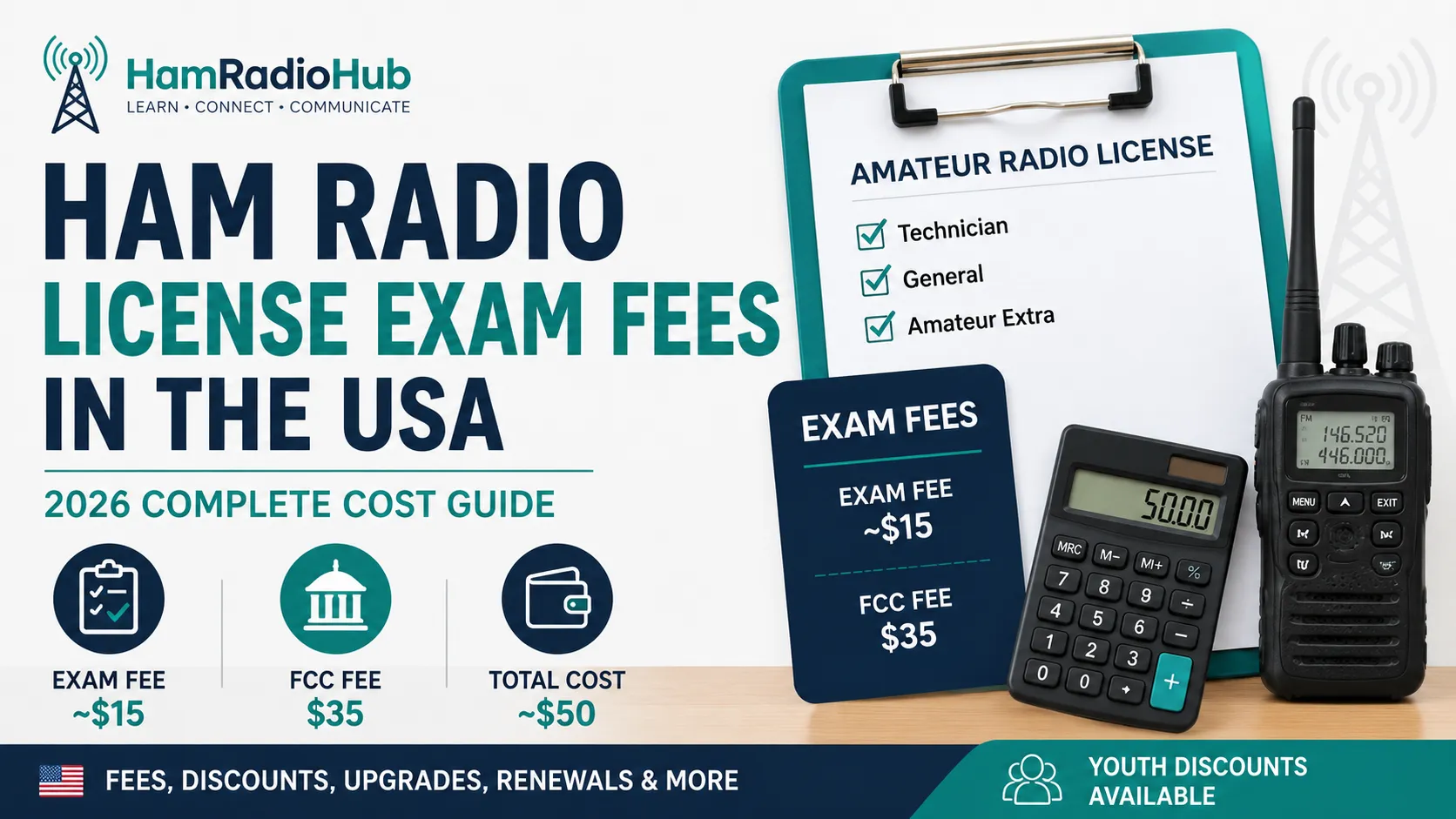
Well!! For most adult applicants in the United States, getting a new amateur radio license runs about $50 total. That figure is made up of two separate charges:
An examination session fee — paid to the volunteer examiner (VE) team that administers your test
An FCC application fee — paid directly to the FCC after you pass
Everything beyond that — study guides, practice exam apps, video courses — is optional. You could technically get licensed for $50 flat if you study using free resources, which plenty of hams do.
Breaking Down the Two Required Fees
The Examination Session Fee
Amateur radio exams aren’t administered by the FCC directly. They’re run by Volunteer Examiner Coordinators (VECs) — organizations like the American Radio Relay League (ARRL) — working through local teams of certified Volunteer Examiners. These are typically licensed hams in your area who volunteer their time to proctor exams, often at libraries, community centers, or club meeting spaces.
That session comes with a small administrative fee, usually around $15, collected on the spot by the VE team. It covers the cost of materials, coordination with the VEC, and processing your paperwork. Some clubs occasionally waive it for newcomers or run free sessions, so it’s worth asking around locally before you assume $15 is set in stone.
If you don’t pass on your first attempt, you’ll generally need to pay that session fee again to retake the exam at a future session. One nice perk, though: many VE teams let you attempt the next license class up in the same sitting at no extra charge. Pass your Technician exam and still have time and energy left? Ask if you can go straight into the General exam — plenty of teams allow it, and it can save you a whole separate testing trip
The FCC Application Fee
Here’s the part that trips people up: passing your exam doesn’t mean you’re licensed yet. Once you pass, your VE team submits your results to the FCC, and the agency emails you payment instructions for a $35 application fee, paid online through the FCC’s CORES system.
This isn’t something you hand over at the testing table — it happens later, from your own computer or phone, after the FCC has your paperwork. And there’s a real deadline attached: you have 10 calendar days from when the FCC issues your application file number to complete payment. Miss that window and your application gets dismissed. You’d have to start the process over, which usually means paying the VE team’s resubmission fee and going through the whole flow again.
So check your email (including spam) after your exam. That FCC message is easy to miss if you’re not expecting it.
Total Cost to Get Licensed
| Expense | Typical Cost |
|---|---|
| Examination Session Fee | ~$15 |
| FCC Application Fee | $35 |
| Total for Most Adults | ~$50 |
That $50 covers you for a full 10 years before renewal is required — works out to roughly $5 a year for a federally issued license that opens up VHF, UHF, and (depending on your class) HF privileges worldwide.
Youth Discounts: Getting Younger Operators on the Air
Amateur radio has an aging population problem, and the community knows it. That’s part of why there are real financial incentives to get younger people licensed. Candidates under 18 who test through an ARRL-affiliated VE team can often qualify for meaningful savings.
Reduced exam fee: Eligible youth candidates typically pay just $5 for the session fee, instead of the standard $15.
FCC fee reimbursement: Through the ARRL Youth Licensing Grant Program, eligible candidates can be reimbursed the $35 FCC application fee after their license is issued.
In practice, that means a motivated teenager could end up spending only a few dollars out of pocket to become a fully licensed amateur radio operator. If you’re a parent looking into this for a kid, it’s worth confirming eligibility with the specific VE team beforehand, since not every session participates in the program.
Do You Need to Buy Study Materials?
Study materials aren’t required, and they’re not bundled into any of the fees above — but skipping them entirely is a bit like showing up to a driving test without ever reading the manual. Most people benefit from at least some structured prep, especially since the Technician exam draws from a public question pool that’s fully published in advance.
Common study options include:
- Class-specific study guides (Technician, General, Amateur Extra)
- Online practice exams
- Video training courses
- Mobile study apps
Prices vary a lot by publisher and format, and free options exist too — several sites let you drill the actual question pool at no cost. There’s no wrong way to study as long as you’re actually retaining the material, not just memorizing answer letters.
Here are some books for preparation: (Actual prices may vary time by time)
The Study Guide for the Technician Class License Exam available for $29.95 plus shipping.
Similarly the Study Guide for the General Class License Exam available for $31.00 plus shipping.
Study guide for Amateur Extra Class License Exam is available at around $33.00 plus shipping.
If you’re already prepared for the exam, here is the a checklist before going for the examination.
What Upgrading Your License Costs?
Once you’re licensed, plenty of operators eventually chase the next class up — Technician to General, then General to Amateur Extra — to unlock more frequencies and operating modes. The fee structure for upgrades is simpler than you might expect.
Technician to General, and General to Amateur Extra
Both upgrade paths work the same way:
- Pass the relevant class exam
- Pay the VE team’s examination session fee
There’s no additional FCC application fee for upgrades that don’t change your call sign — the $35 charge applies to new licenses, renewals, and vanity call sign requests, not to moving up a license class. That makes upgrading noticeably cheaper than getting licensed the first time around.
Renewal Fees: What Happens After 10 Years
Your amateur radio license doesn’t last forever — it’s valid for 10 years from issuance or renewal. When it’s time to renew, you’ll submit a renewal application to the FCC and pay the $35 renewal fee. No exam is required for a routine renewal completed within the allowed renewal window, so this one’s straightforward as long as you don’t let your license lapse for too long past expiration.
Here is Full guide on Ham Radio License Renewal Process:
Vanity Call Sign Fees
Plenty of hams eventually want a call sign that’s easier to remember, reflects their name, or has some personal meaning — that’s what a vanity call sign is for. Requesting one through the FCC costs $35, the same as a new license or renewal application.
What’s Free: Administrative Changes
Not everything costs money. Updating basic information on file with the FCC — your mailing address, your name, or your email — doesn’t trigger any fee. That said, it’s still worth doing promptly. The FCC communicates important deadlines (like that 10-day payment window) by email, so outdated contact information can genuinely cost you a license application if a message goes to a dead inbox.
FAQs on HAM radio exam fees:
What happens if I fail the exam more than once?
There’s no limit on how many times you can retake an amateur radio exam. Each attempt typically requires paying the VE team’s session fee again, since it’s a per-session charge rather than a per-person one. Many candidates find it helpful to study more targeted areas of the question pool after a failed attempt rather than restarting from scratch — that usually makes the next try much smoother.
Can I get a refund if I decide not to complete my license application?
No. The FCC application fee is non-refundable once paid, and this applies even if an application is later dismissed for missing the payment deadline. This is a big reason to pay promptly as soon as you receive the FCC’s payment instructions rather than putting it off, since a missed 10-day window means paying to resubmit rather than getting money back.
Does military or veteran status affect any of these fees?
The standard FCC application and VE session fees apply regardless of military or veteran status — there’s no blanket federal discount tied to service. That said, individual VE teams or local clubs sometimes offer their own fee waivers or reduced session costs for veterans, so it’s worth asking your specific testing team directly rather than assuming a policy either way.
Conclusion:
Budget around $50, pick a VE team near you or an online remote session, and give yourself a few weeks with a study guide before test day. The fees are small and predictable — the real work is just learning the material, and that part is entirely up to you and how much time you put in. Once your call sign shows up in the FCC database, the ten years of privileges that follow make the whole process feel like one of the better fifty-dollar decisions you’ll make this year.
Other blog posts from the category:
- Ham Radio for Beginners: All in 1 Ultimate Guide in 2025
- How to renew Ham Radio License USA: A Step-by-Step Guide
- Ham Radio Books: 9 Handpicked Books for You!!
- How to Get Your Ham Radio License in the USA 2026: A Beginner’s Step-by-Step Guide
- HAM radio license exam checklist USA 2026
- HAM Radio License Exam Fees in the USA (2026): What You’ll Actually Pay

